Pololu Digital Distance Sensor
This compact sensor is a great way to quickly detect the presence of nearby objects.
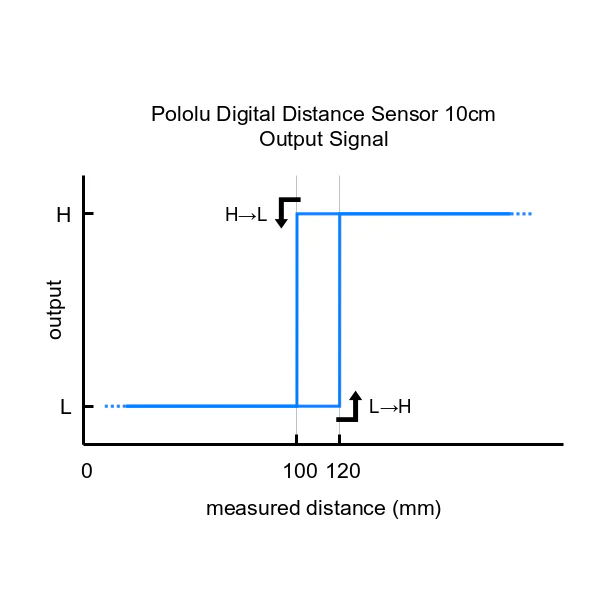
As long as the sensor is enabled, it takes continuous distance measurements and uses a single digital output to indicate if it detects an object within its detection range. The output is driven low when the sensor detects an object; otherwise, the output is high.
It works over an input voltage range of 3.0 V to 5.5 V, and the 0.1″ pin spacing makes it easy to use with standard solderless breadboards and 0.1″ perfboards.
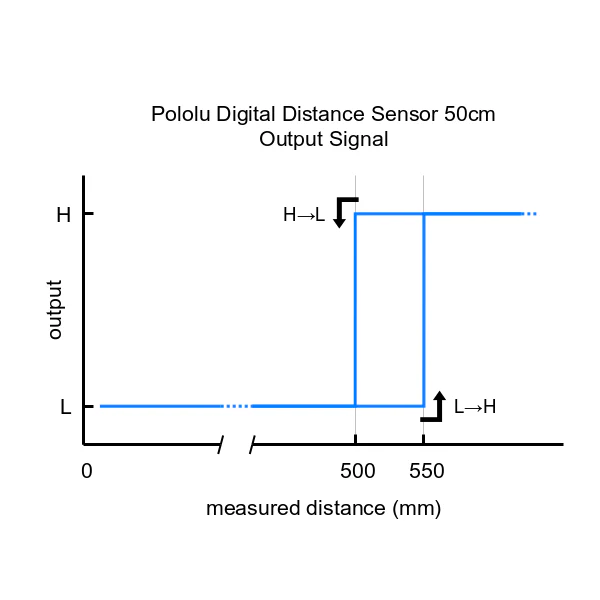
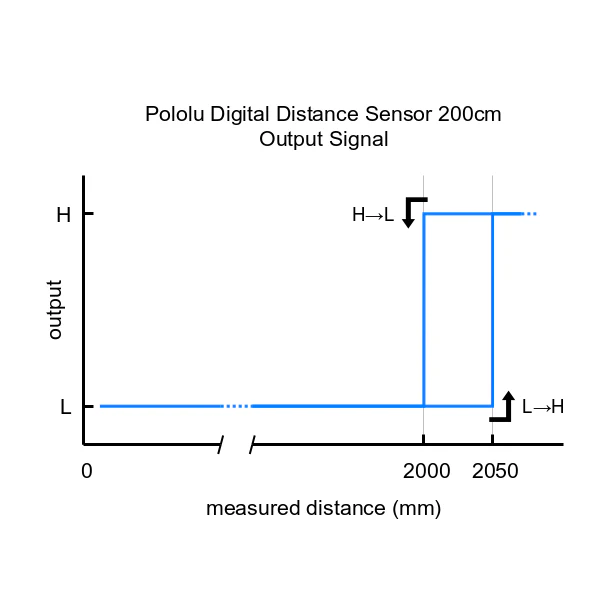
Please note that this sensor will only tell you if there is an object within the detection range along its line of sight, not how far away it is. As shown in the diagram above, there is hysteresis at the maximum range threshold to help ensure a clean transition as objects cross the threshold.
Unlike simpler optical sensors that use the intensity of reflected light to detect objects, this sensor uses a short-range lidar module to precisely measure how long it takes for emitted pulses of infrared, eye-safe laser light to reach the nearest object and be reflected back. This allows the sensor performance to be largely independent of object reflectivity and ambient lighting conditions (though the range can be reduced for extremely low-reflectance objects).
Some example applications include:
- break-beam sensor or photogate alternative
- non-contact bumper or obstacle detector for a robot
- non-contact interface element for activating a device or process
- a counter or timer of objects as they pass by
Specifications
- Operating voltage: 3.0 V to 5.5 V
- Current consumption: 30 mA (typical) when enabled, 0.4 mA when disabled
- Field of view (FOV): 15° typical; can vary with object reflectance and ambient conditions
- Output type: digital signal (low when detecting an object, high otherwise)
- Dimensions: 0.85″ × 0.35″ × 0.122″ (21.6 × 8.9 × 3.1 mm): see the dimension diagram for more information
- Weight: 0.014 oz (0.4 g)
Using the sensor
Important note: This product might ship with a protective liner covering the sensor IC. The liner must be removed for proper sensing performance.

Three connections are necessary to use this module: VIN, GND, and OUT. These pins are accessible through a row of 0.1″-pitch through holes, which work with standard 0.1″ (2.54 mm) male headers and 0.1″ female headers (available separately). The VIN pin should be connected to a 3 V to 5.5 V source, and GND should be connected to 0 volts. The OUT pin drives low (0 V) when an object is being detected and it drives high (to the VIN level) when an object is not being detected. It is weakly pulled high when the sensor is disabled or waiting for its first reading to complete after power-up. A red LED on the back side of the board also lights whenever an object is detected.
The board has an optional ENABLE pin that can be driven low to put it into a low-power state that consumes approximately 0.4 mA. This pin can be accessed through a via or its neighboring surface-mount pad on the back side labeled “EN” on the silkscreen. The ENABLE pin is pulled up to VIN, enabling the sensor by default.
The board features four surface-mount configuration jumpers that determine its operation mode. Different versions of the Pololu Digital Distance sensors ship with the appropriate jumpers pre-populated with 0 Ω resistors. These resistors can be desoldered from the populated spots or solder bridges can be added across the unpopulated spots to convert one sensor version into another. The table in the section below shows the jumper settings for the different versions.
The board has one mounting hole intended for use with #2 or M2 screws.
The Pololu Digital Distance Sensor family
We have several different versions of Pololu Digital Distance Sensors, all with the same dimensions and pinout:
| Output type | Sensor | Maximum range | Resolution | Minimum update rate | Jumper settings (4321) |
|---|---|---|---|---|---|
|
digital (does not provide distance measurement) |
POL-4050: Digital output, 5cm | 5 cm | - | 145 Hz | 0000 |
| POL-4052: Digital output, 10cm | 10 cm | - | 115 Hz | 0010 | |
| POL-4054: Digital output, 15cm | 15 cm | - | 95 Hz | 0100 | |
| POL-4066: Digital output, 25cm | 25 cm | - | 100 Hz | 0000 | |
| POL-4067: Digital output, 50cm | 50 cm | - | 100 Hz | 0001 | |
| POL-4069: Digital output, 100cm | 100 cm | - | 100 Hz | 0011 | |
| POL-4077: Digital output, 200cm | 200 cm | - | 30 Hz | 1011 | |
|
pulse width (provides distance measurement) |
POL-4064: Pulse width output, 50cm max | 50 cm | 3 mm | 50 Hz | 1110 |
| POL-4071: Pulse width output, 130cm max | 130 cm | 1 mm | 100 Hz | 0101 | |
| POL-4079: Pulse width output, 300cm max | 300 cm | 2 mm | 30 Hz | 1101 |
Original: $10.50
-70%$10.50
$3.15More Images






Pololu Digital Distance Sensor
This compact sensor is a great way to quickly detect the presence of nearby objects.
As long as the sensor is enabled, it takes continuous distance measurements and uses a single digital output to indicate if it detects an object within its detection range. The output is driven low when the sensor detects an object; otherwise, the output is high.
It works over an input voltage range of 3.0 V to 5.5 V, and the 0.1″ pin spacing makes it easy to use with standard solderless breadboards and 0.1″ perfboards.
Please note that this sensor will only tell you if there is an object within the detection range along its line of sight, not how far away it is. As shown in the diagram above, there is hysteresis at the maximum range threshold to help ensure a clean transition as objects cross the threshold.
Unlike simpler optical sensors that use the intensity of reflected light to detect objects, this sensor uses a short-range lidar module to precisely measure how long it takes for emitted pulses of infrared, eye-safe laser light to reach the nearest object and be reflected back. This allows the sensor performance to be largely independent of object reflectivity and ambient lighting conditions (though the range can be reduced for extremely low-reflectance objects).
Some example applications include:
- break-beam sensor or photogate alternative
- non-contact bumper or obstacle detector for a robot
- non-contact interface element for activating a device or process
- a counter or timer of objects as they pass by
Specifications
- Operating voltage: 3.0 V to 5.5 V
- Current consumption: 30 mA (typical) when enabled, 0.4 mA when disabled
- Field of view (FOV): 15° typical; can vary with object reflectance and ambient conditions
- Output type: digital signal (low when detecting an object, high otherwise)
- Dimensions: 0.85″ × 0.35″ × 0.122″ (21.6 × 8.9 × 3.1 mm): see the dimension diagram for more information
- Weight: 0.014 oz (0.4 g)
Using the sensor
Important note: This product might ship with a protective liner covering the sensor IC. The liner must be removed for proper sensing performance.
Three connections are necessary to use this module: VIN, GND, and OUT. These pins are accessible through a row of 0.1″-pitch through holes, which work with standard 0.1″ (2.54 mm) male headers and 0.1″ female headers (available separately). The VIN pin should be connected to a 3 V to 5.5 V source, and GND should be connected to 0 volts. The OUT pin drives low (0 V) when an object is being detected and it drives high (to the VIN level) when an object is not being detected. It is weakly pulled high when the sensor is disabled or waiting for its first reading to complete after power-up. A red LED on the back side of the board also lights whenever an object is detected.
The board has an optional ENABLE pin that can be driven low to put it into a low-power state that consumes approximately 0.4 mA. This pin can be accessed through a via or its neighboring surface-mount pad on the back side labeled “EN” on the silkscreen. The ENABLE pin is pulled up to VIN, enabling the sensor by default.
The board features four surface-mount configuration jumpers that determine its operation mode. Different versions of the Pololu Digital Distance sensors ship with the appropriate jumpers pre-populated with 0 Ω resistors. These resistors can be desoldered from the populated spots or solder bridges can be added across the unpopulated spots to convert one sensor version into another. The table in the section below shows the jumper settings for the different versions.
The board has one mounting hole intended for use with #2 or M2 screws.
The Pololu Digital Distance Sensor family
We have several different versions of Pololu Digital Distance Sensors, all with the same dimensions and pinout:
| Output type | Sensor | Maximum range | Resolution | Minimum update rate | Jumper settings (4321) |
|---|---|---|---|---|---|
|
digital (does not provide distance measurement) |
POL-4050: Digital output, 5cm | 5 cm | - | 145 Hz | 0000 |
| POL-4052: Digital output, 10cm | 10 cm | - | 115 Hz | 0010 | |
| POL-4054: Digital output, 15cm | 15 cm | - | 95 Hz | 0100 | |
| POL-4066: Digital output, 25cm | 25 cm | - | 100 Hz | 0000 | |
| POL-4067: Digital output, 50cm | 50 cm | - | 100 Hz | 0001 | |
| POL-4069: Digital output, 100cm | 100 cm | - | 100 Hz | 0011 | |
| POL-4077: Digital output, 200cm | 200 cm | - | 30 Hz | 1011 | |
|
pulse width (provides distance measurement) |
POL-4064: Pulse width output, 50cm max | 50 cm | 3 mm | 50 Hz | 1110 |
| POL-4071: Pulse width output, 130cm max | 130 cm | 1 mm | 100 Hz | 0101 | |
| POL-4079: Pulse width output, 300cm max | 300 cm | 2 mm | 30 Hz | 1101 |
Product Information
Product Information
Shipping & Returns
Shipping & Returns
Description
This compact sensor is a great way to quickly detect the presence of nearby objects.
As long as the sensor is enabled, it takes continuous distance measurements and uses a single digital output to indicate if it detects an object within its detection range. The output is driven low when the sensor detects an object; otherwise, the output is high.
It works over an input voltage range of 3.0 V to 5.5 V, and the 0.1″ pin spacing makes it easy to use with standard solderless breadboards and 0.1″ perfboards.
Please note that this sensor will only tell you if there is an object within the detection range along its line of sight, not how far away it is. As shown in the diagram above, there is hysteresis at the maximum range threshold to help ensure a clean transition as objects cross the threshold.
Unlike simpler optical sensors that use the intensity of reflected light to detect objects, this sensor uses a short-range lidar module to precisely measure how long it takes for emitted pulses of infrared, eye-safe laser light to reach the nearest object and be reflected back. This allows the sensor performance to be largely independent of object reflectivity and ambient lighting conditions (though the range can be reduced for extremely low-reflectance objects).
Some example applications include:
- break-beam sensor or photogate alternative
- non-contact bumper or obstacle detector for a robot
- non-contact interface element for activating a device or process
- a counter or timer of objects as they pass by
Specifications
- Operating voltage: 3.0 V to 5.5 V
- Current consumption: 30 mA (typical) when enabled, 0.4 mA when disabled
- Field of view (FOV): 15° typical; can vary with object reflectance and ambient conditions
- Output type: digital signal (low when detecting an object, high otherwise)
- Dimensions: 0.85″ × 0.35″ × 0.122″ (21.6 × 8.9 × 3.1 mm): see the dimension diagram for more information
- Weight: 0.014 oz (0.4 g)
Using the sensor
Important note: This product might ship with a protective liner covering the sensor IC. The liner must be removed for proper sensing performance.
Three connections are necessary to use this module: VIN, GND, and OUT. These pins are accessible through a row of 0.1″-pitch through holes, which work with standard 0.1″ (2.54 mm) male headers and 0.1″ female headers (available separately). The VIN pin should be connected to a 3 V to 5.5 V source, and GND should be connected to 0 volts. The OUT pin drives low (0 V) when an object is being detected and it drives high (to the VIN level) when an object is not being detected. It is weakly pulled high when the sensor is disabled or waiting for its first reading to complete after power-up. A red LED on the back side of the board also lights whenever an object is detected.
The board has an optional ENABLE pin that can be driven low to put it into a low-power state that consumes approximately 0.4 mA. This pin can be accessed through a via or its neighboring surface-mount pad on the back side labeled “EN” on the silkscreen. The ENABLE pin is pulled up to VIN, enabling the sensor by default.
The board features four surface-mount configuration jumpers that determine its operation mode. Different versions of the Pololu Digital Distance sensors ship with the appropriate jumpers pre-populated with 0 Ω resistors. These resistors can be desoldered from the populated spots or solder bridges can be added across the unpopulated spots to convert one sensor version into another. The table in the section below shows the jumper settings for the different versions.
The board has one mounting hole intended for use with #2 or M2 screws.
The Pololu Digital Distance Sensor family
We have several different versions of Pololu Digital Distance Sensors, all with the same dimensions and pinout:
| Output type | Sensor | Maximum range | Resolution | Minimum update rate | Jumper settings (4321) |
|---|---|---|---|---|---|
|
digital (does not provide distance measurement) |
POL-4050: Digital output, 5cm | 5 cm | - | 145 Hz | 0000 |
| POL-4052: Digital output, 10cm | 10 cm | - | 115 Hz | 0010 | |
| POL-4054: Digital output, 15cm | 15 cm | - | 95 Hz | 0100 | |
| POL-4066: Digital output, 25cm | 25 cm | - | 100 Hz | 0000 | |
| POL-4067: Digital output, 50cm | 50 cm | - | 100 Hz | 0001 | |
| POL-4069: Digital output, 100cm | 100 cm | - | 100 Hz | 0011 | |
| POL-4077: Digital output, 200cm | 200 cm | - | 30 Hz | 1011 | |
|
pulse width (provides distance measurement) |
POL-4064: Pulse width output, 50cm max | 50 cm | 3 mm | 50 Hz | 1110 |
| POL-4071: Pulse width output, 130cm max | 130 cm | 1 mm | 100 Hz | 0101 | |
| POL-4079: Pulse width output, 300cm max | 300 cm | 2 mm | 30 Hz | 1101 |